Superintelligence
Bostrom's definitive academic text rigorously maps the strategies, kinetics, and dangers of an intelligence explosion, making the case that alignment is civilization-critical.
Non-fiction books on AI safety, alignment, and related topics—from primers to foundational texts.
Browse this category in the interactive library →
Bostrom's definitive academic text rigorously maps the strategies, kinetics, and dangers of an intelligence explosion, making the case that alignment is civilization-critical.
Kurzweil presents a maximalist case for merging with machines backed by decades of exponential trend data, shaping how the public and policymakers think about AI timelines.
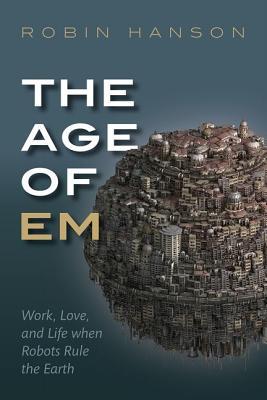
Hanson applies rigorous economics to a world of brain emulations, modeling how AI-era wages, wars, and social structures could actually function.
Russell argues the standard AI paradigm of optimizing fixed objectives is fundamentally dangerous, proposing instead that machines should defer to uncertain human preferences.
Christian traces the technical and historical roots of alignment, showing why objective misspecification keeps recurring across every AI paradigm from expert systems to deep learning.
Tegmark maps concrete governance and alignment choices that determine whether advanced AI expands human agency or permanently concentrates power.
Hendrycks' textbook surveys technical failure modes, governance constraints, and ethical trade-offs in deploying advanced AI, suitable as a first course in the field.
McKee synthesizes the core x-risk arguments into an accessible, urgent case for why superintelligence governance and alignment research cannot wait.
Shane uses concrete and often hilarious ML failures to explain why AI systems can be impressive yet brittle, biased, and dangerously easy to mis-specify.
Fry examines real algorithmic decision systems in justice, medicine, and transport to show where AI improves outcomes and where accountability structures fail.
Lee maps the US-China AI race and explains how geopolitical competition can accelerate deployment well before safety institutions are ready.
Ord situates AI among existential risks and argues our current governance capacity is dangerously inadequate for the transformative systems being built.
Kearns and Roth give technical foundations for fairness, privacy, and accountability in algorithms, prerequisites for any credible AI safety framework.

Scharre details how military AI autonomy changes escalation dynamics and why human-in-the-loop control mechanisms consistently lag behind battlefield capability.
Kurzweil's early timeline forecasts shaped modern discourse on AI trajectories and remain a key reference point for evaluating long-horizon predictions.
The standard technical reference for deep learning, essential context for understanding the architectures and training methods that alignment research targets.
Mitchell offers a grounded, skeptical look at current AI capabilities, countering hype with hard limits and clarifying what today's systems actually can and cannot do.
Gawdat frames the alignment problem through the emotional lens of parenting a superintelligent child, making existential risk visceral for a general audience.
Suleyman argues that containing omni-use technologies like AI is the defining geopolitical challenge of the century, proposing a containment framework from inside the industry.
Tetlock teaches the cognitive tools needed to predict technological risks with better-than-random accuracy, directly useful for AI timeline and governance forecasting.

Galef explains how to seek truth over comfort, a critical psychological stance for honestly confronting AI risks without retreating into denial or panic.
Kahneman reveals the cognitive biases that prevent humans from intuitively grasping exponential growth, tail risks, and the kind of strategic thinking AI safety demands.
Mollick offers a practical guide for working alongside current LLMs while understanding their jagged capability frontiers and failure modes.
Hofstadter explores how consciousness and meaning can emerge from formal systems that look meaningless locally, the deepest conceptual puzzle behind machine intelligence.

Bennett traces the evolution of intelligence from single-celled organisms to modern brains, clarifying what makes aligned cognition biologically difficult and computationally treacherous.
Deutsch argues that knowledge creation is unbounded and all problems are solvable in principle, grounding the optimistic case that alignment is achievable.
Metz provides the definitive narrative history of the deep learning revolution and the personalities, rivalries, and safety concerns that shaped it.
Wiener founded the study of feedback and control systems, anticipating by decades the governance problems that arise when intelligent machines act on their own models of the world.
Moravec predicts a future in which robotic descendants supersede humans through technological evolution, an early and influential take on the human obsolescence scenario.
Minsky proposes that intelligence emerges from many small non-intelligent processes coordinated at scale, a framework that anticipated multi-agent AI architectures.
Hawkins argues that hierarchical prediction is the core organizing principle of biological intelligence, offering a lens for evaluating how artificial systems differ.
Harari explores the transition toward data-driven authority where algorithms may know us better than we know ourselves, eroding the basis for human autonomy.
Pinker argues that reason and science have historically improved human welfare, grounding the optimistic counterpoint to doomer narratives about AI.
Deutsch unifies physics, evolution, epistemology, and computation into a single worldview about what is possible, providing deep context for reasoning about superintelligence.
Baudrillard explains how representations can displace reality entirely, a prescient lens for understanding generative AI media saturation and epistemic erosion.
Carse distinguishes short-horizon winning from preserving the long game, a useful framing for AI governance where the goal is keeping options open, not racing to win.
Mitchell explains how complex behavior emerges from simple rules, foundational for understanding why adaptive AI systems resist top-down control.
Kelly argues that the most powerful systems must be cultivated rather than rigidly engineered, anticipating challenges in controlling emergent AI behavior.
Brand argues for responsible stewardship of high-powered technologies rather than blanket rejection, a pragmatic stance applicable to AI governance.
Clarke's forecasting framework, including his famous three laws, remains a classic guide to thinking clearly about radical technological change.
The foundational edited volume on existential and global risks, including AI, widely cited in alignment curricula as the starting point for cross-risk thinking.
Yudkowsky and Soares compress two decades of MIRI argument into a blunt, bestselling case that building superintelligence with anything like current techniques means human extinction.
Hao's award-winning investigative history of OpenAI traces how safety commitments collide with scale-at-all-costs ambition inside the world's most consequential AI lab.
Harari extends his history-of-civilization project to information networks themselves, arguing that AI is not just a tool but a new kind of independent agent whose misalignment could unravel the shared fictions every human society depends on.
Mallaby's biography of Demis Hassabis traces DeepMind's arc from AGI dreamers to the center of the superintelligence race, dramatizing the internal tension between racing to build powerful AI and trying to keep it safe.